Aftercare
Snow on Solar Panels: Why It’s Best Left Alone, and When to Call Us
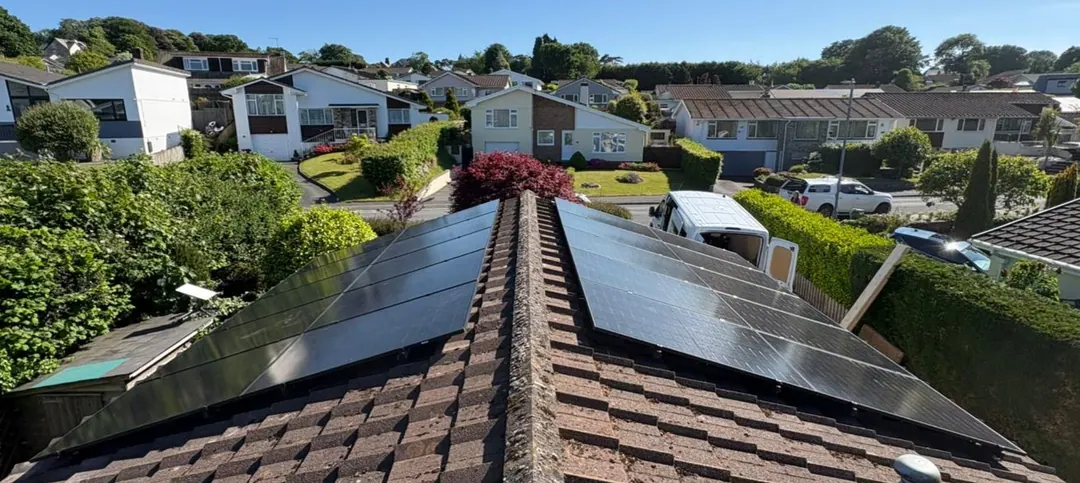
Snow on solar panels is an uncommon sight in most of Devon, and when it does settle, the best thing you can do is usually nothing. Panel glass is smooth, so snow slides off it more easily than off the rest of the roof, and the MCS standards that installations follow allow for the weight of snow. Here’s where it really falls, what it costs in output and how to stay safe.
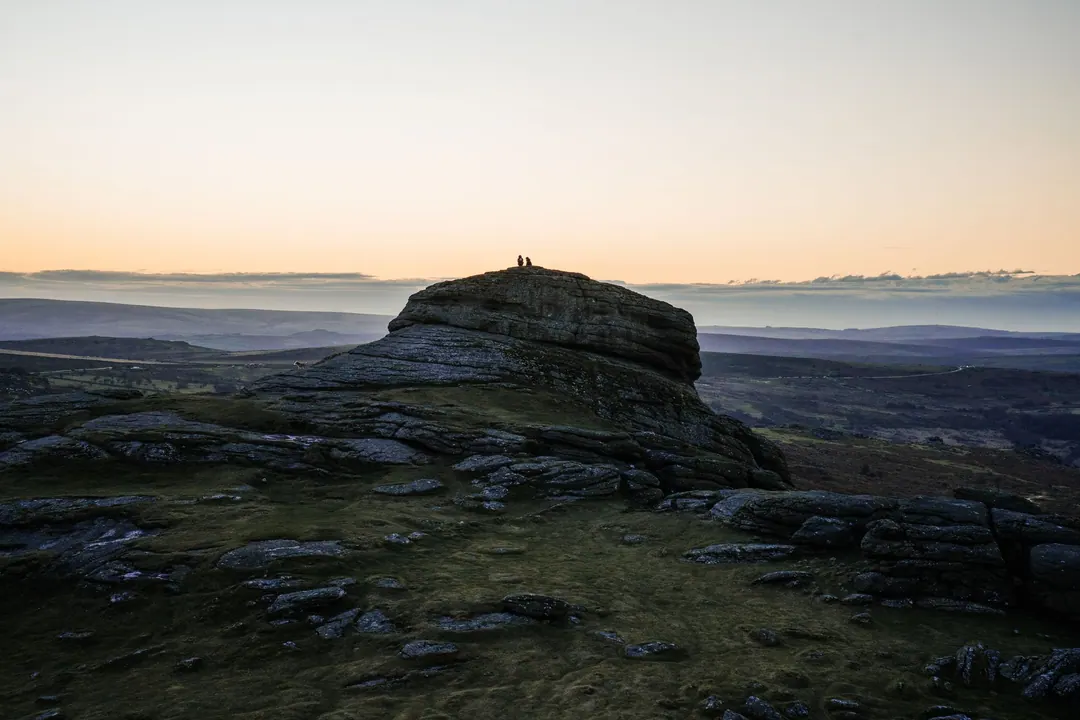
Where it snows in Devon: the moors, not the coast
Height makes a big difference. The Met Office’s climate summary for South West England gives these typical figures, counting a day of lying snow only when more than half the ground is covered at 9am:
| Where | Days with snow falling | Days a year with snow lying |
|---|---|---|
| Coastal Devon and Cornwall, and Scilly | Fewer than 10 | Fewer than 3 |
| Inland parts of the South West | About 8 to 15 | 5 to 10 |
| Dartmoor and Exmoor | More than 25 possible | More than 20 |
Dartmoor reaches 621 metres and Exmoor 521 metres, and the Met Office’s rough guide is about five more days of snow falling, and five more days of snow lying, for every 100 metres of height. In lowland areas, about a third of years record no lying snow at all. For comparison, the UK averages 13 days of lying snow a year on the Met Office’s 1991 to 2020 figures.
Snow normally falls between November and April, and rarely lies outside December to March. Heavy falls do happen: around 50cm fell in inland Devon on 18 and 19 February 1978.
Frost and ice: more common than lying snow
Even where snow is rare, frost isn’t. An air frost means the temperature 1.25 metres above the ground has dropped below 0°C. The Met Office’s 1991 to 2020 averages:
| Met Office station | Air frosts in an average year |
|---|---|
| Plymouth, Mountbatten | About 13 |
| Bovey Tracey, Yarner Wood | About 23 |
| Liscombe, Somerset, 348 metres up | About 36 |
Leave frost or ice on the glass to clear by itself. Trina says cleaning tools mustn’t wear the glass, and LONGi says never to clean with a rough tool.
Why snow slides off solar panels
Panels shed snow more readily than the rest of a roof. Sharp’s installation manual puts it plainly: snow slides more easily on the smooth surface of a panel than on other parts of the roof, and it may slide suddenly and fall off the roof. MIS 3002, the MCS installation standard for solar PV, also deals with the “build-up and shedding of snow” from arrays.
So the usual answer to “should I clear my panels?” is no: give the snow time. The exception, a thick layer that stays put for days, comes below.
Snow loads: what panels and roofs are built to carry
-
The mounting kit. Where a kit for tiles or slates rests its load evenly on the roof covering, MCS 012, the MCS standard for mounting products, requires a downward (snow) load test of at least 1.0kN per square metre, roughly 100kg on every square metre. That figure is rounded up from the highest calculated value for any UK snow zone at 200 metres above sea level.
-
The roof. MIS 3002 requires the installer to have the roof structure checked by a competent person. One of its methods deducts the likely snow load for the location, taken from Eurocode 1, and roofs with more potential for snow build-up, such as those with dormers, valleys or parapets, go to a structural engineer.
-
The panels. Trina’s current Vertex manual gives its load figures as test loads. Design loads apply a safety factor of 1.5, depend on the location and local climate, and are set by the racking supplier or an engineer.
Princetown, 414 metres up on Dartmoor, sits more than 200 metres above the height behind MCS 012’s figure, and MIS 3002’s method uses the snow load for the location itself. Damage is still possible: Sharp warns that extreme snow build-up can deform a panel’s frame, and that overhanging snow and ice can do the same. The same manual says not to carry out any servicing unless you’re qualified. Our page on solar panel installation explains how every system we fit starts with a free site survey.
Never climb up: safety rules for snow on solar panels
-
Never climb onto the roof, and never use a ladder. Snow and ice make both dangerous, and panel glass is slippery: Sharp says not to stand or step on its panels.
-
Never pour hot water on the panels. Trina keeps cleaning water within -5°C to 10°C of the panel’s own temperature and rules out steam cleaners. A kettle on frozen glass is far outside that.
-
Never use a brush on a pole or a roof rake. Rough tools can wear the glass, and pulling snow down from below brings it, and any ice, down on you.
-
Never use anything sharp. No scrapers, shovels or knives to chip at ice.
-
Never use de-icer, salt or other chemicals. Sharp says not to clean the glass with chemicals.
-
Keep clear of the eaves below the panels while the snow is thawing.
Panels are live in daylight, snow or not. LONGi points out that a panel has no switch: it stops working only when it’s kept from light. Trina warns that in daylight the voltage and current in an array are enough to cause a fatal electric shock. Anything electrical, from the isolators to the inverter, is a job for a qualified installer.
Do panels make any power under snow?
Not much while they’re covered. Snow keeps daylight off the cells, and LONGi says shading, full or partial, significantly reduces output. Once the glass clears, snow can help: LONGi’s manual notes that snow and other reflective surroundings increase a panel’s current and power, and that its voltage and power rise in low temperatures.
Lingering snow is different. Trina says snow covering much of the panels should be cleared in time, because partial shade as it melts can cause hot spots, and its cleaning instructions are written for professional installers. If a thick layer stays put for days, or leaves part of the array covered, ring us for advice rather than tackling it yourself.
What a snowy spell costs in output
We ran PVGIS, the EU Joint Research Centre’s solar model, for a 4kWp system near Okehampton, facing south at 35° with 14% system losses. Our guide to what solar PV is explains kWp.
| Month | Generation in the month | Average a day |
|---|---|---|
| December | 125 kWh | 4.0 kWh |
| January | 141 kWh | 4.5 kWh |
| February | 201 kWh | 7.2 kWh |
| June | 471 kWh | 15.7 kWh |
| Whole year | 3,913 kWh | 10.7 kWh |
December to February together make about 12% of the year’s output in this model. If snow covered the panels for five whole days in January, the loss at the January average would be about 23kWh, around 0.6% of the year. PVGIS doesn’t model snow separately: its 14% loss allowance covers things such as cables, the inverter and, in its words, “dirt (sometimes snow) on the modules”. These are model averages, not a forecast for your roof, but a few snowy days cost little, and none of it is worth a fall.
Sliding snow: keep clear below the panels
Sharp says snow may suddenly slide, fall off the roof and hit nearby objects, and suggests preventive measures such as a snow stopper where that could cause injury or damage. MIS 3002 takes the same view at the roof edge: panels within 400mm of the edge need measures to make sure the build-up and shedding of snow can’t cause injury or property damage.
During a thaw, keep children, pets and cars away from the eaves below the panels. If your panels sit above a door, path or parking space, mention it at your survey or health check.
Checks to make from the ground once it has gone
The maintenance schedule in MIS 3002 gives owners a few checks of their own, none of them on the roof:
-
Look at the panels from ground level for slipped panels, damage or dirt.
-
Look for signs of structural distress, which the schedule flags particularly after heavy winter snow.
-
Look at the inverter, where it’s safe to get to, for signs of a fault or damage.
-
Check that your recorded generation is still going up, on the meter or in the app.
Your app can show what the garden can’t. Our guide to the signs your system needs a health check covers what to look for.
When snow or ice has damaged something
Call us if you spot a cracked or slipped panel, a bent frame, loose fixings, a warning light on the inverter or an alert in the app. Fault-finding is a job for a qualified electrician, and our team includes a solar PV electrician. Our solar panel repair and fault-finding service covers systems we didn’t fit as well as our own, and we find the cause rather than guessing from the symptoms.
If a winter storm cuts the power
Devon is served by National Grid Electricity Distribution’s South West network. NGED says most low carbon technologies, solar panels included, have protective systems that disconnect them in a fault, such as a power cut caused by severe weather, and that a system without standby or island mode is designed to shut down during an outage. Our guide to power cuts in Devon and Cornwall covers who to call, and we design solar battery storage with backup where it’s included and suitable.
Looking after your system through the winter
Snow is one more reason for a proper look once a year. Our one-hour Annual Solar Health Check costs £395 and tests and inspects your system, whoever installed it, and our page on solar panel maintenance and health checks sets out what it covers. A year of The Solar Owners Club comes with every installation we carry out, with an annual system health check, a dedicated support line and drones for close-up roof inspections. Read why owners join the club.
We look after systems for homes across Devon, from Dartmoor villages to Exeter and Plymouth. Wherever you are, when snow lands on your solar panels, stay on the ground, let it slide off, and call us if anything looks wrong once it has gone.