Solar panels · Devon
Solar panels in Plymouth
Our family-run team designs and installs solar panels for homes in Plymouth, plus battery storage if your home suits it, working out of Allerford Farm near Okehampton, about 19 miles as the crow flies from the city centre. Plymouth’s roofs are varied, from traditional slate to a post-war centre where the council encourages solar panels on the many flat roofs.
Or call 07441 369 505

- Workmanship
warranty10years - Family run
since2022 - The Solar Owners
Club included1year
- Conservation areas
- 15
- Terraced homes
- 32.8%
- Post-war homes
- 10.9%
conservation areas across the city
of households live in terraces (England 23.0%)
of homes date from 1945 to 1954 (England 6.3%)
A unitary city
One council plans the whole city
Plymouth City Council has been a unitary authority since 1 April 1998, so it handles planning for the whole city, from Devonport and Stonehouse to Mannamead, Efford and Plympton St Maurice. It also offers householders a paid call with a planning officer to confirm whether permission is needed.
The city sits on the Tamar, with Saltash in Cornwall across the water, and our installers work on both sides of it: see solar panels over the Tamar in Cornwall, Exeter solar installation, solar panels throughout Devon or all the areas we cover.
Housing and materials
Terraces, post-war homes and slate roofs
Terraced homes make up 32.8% of Plymouth’s households (England 23.0%), and detached houses just 11.4%. The city’s housing records show the post-war years clearly: 13,410 of its 123,400 homes (10.9%) were built between 1945 and 1954, against 6.3% nationally, while 17.5% predate 1900.
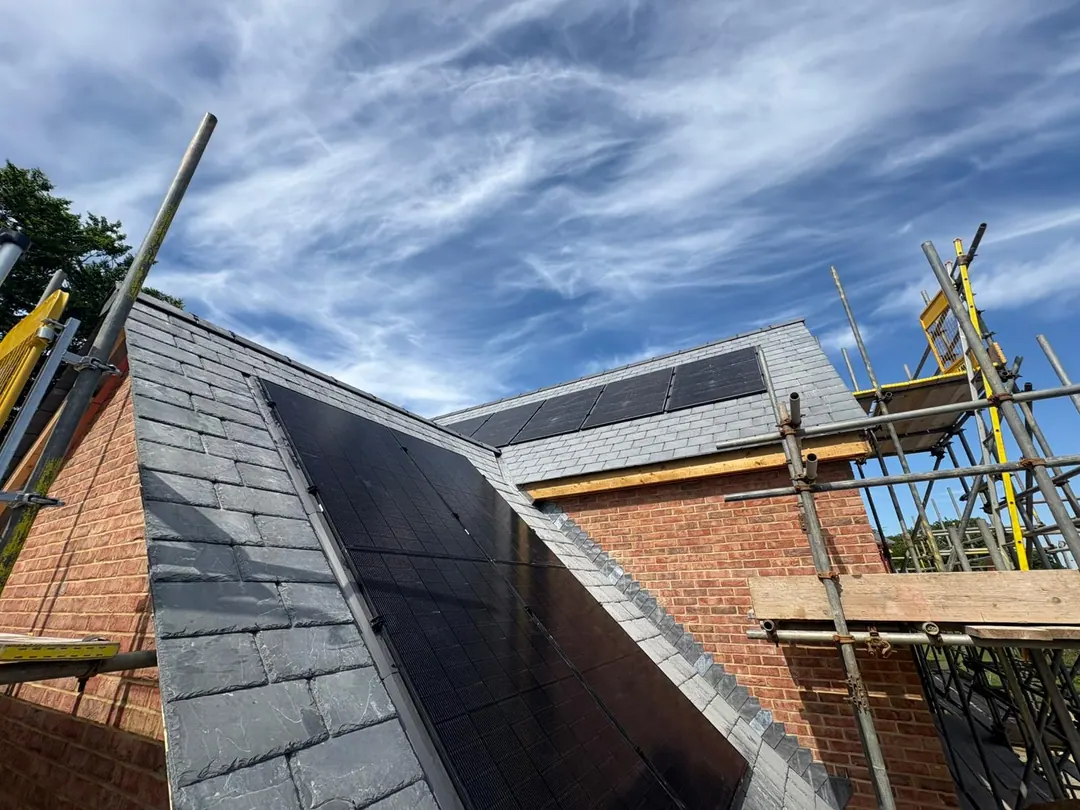
Slate is Plymouth’s traditional roofing, with limestone, granite and local shillet its traditional building materials, as the council’s 2009 appraisal of The Hoe records. Whatever your roof is made of, the survey checks its construction, direction, shading and usable area.
Distance from our base
Plymouth and around
Miles from Allerford Farm, Lewdown, as the crow flies.
Plymouth and the six towns nearest it on our map.
Places in and around Plymouth
- Barbican
- The Hoe
- Devonport
- Stoke
- Stonehouse
- Mannamead
- Mutley
- Peverell
- Efford
- Lipson
- Plympton St Maurice
- Tamerton Foliot
- Turnchapel
The post-war centre
Solar panels on Plymouth’s post-war flat roofs
July 2019
The air raids of March and April 1941 destroyed much of Plymouth’s centre. It was rebuilt to A Plan for Plymouth (1943), drawn up by Patrick Abercrombie and James Paton Watson, and most buildings in the conservation area there today date from the 1950s and 1960s.
Since July 2019 the rebuilt centre has been the City Centre Conservation Area, the first in the country to protect a post-war city centre, by the council’s account, and its 2022 appraisal encourages solar panels on the area’s many flat roofs where they fit its character.
Under the national rules, flat-roof panels in a conservation area need prior approval from the council, which checks their appearance, and must sit no more than 0.6 metres above the roof. We’ll tell you at the survey whether that applies to your property.
Conservation and listing
Conservation areas from the Barbican to Mannamead
Plymouth has 15 conservation areas, among them the Barbican, The Hoe and Devonport. The council says owners there may need its permission before making alterations, and lists installing solar panels as one example. Panels on the roof slope of a house that isn’t listed can still count as permitted development if they keep to the national limits, but not on a street-facing wall, balcony, railing or parapet.
A listed house falls outside permitted development, so panels need planning permission and, where they affect its character, listed building consent. The council’s guidance says less prominent slopes are likely to do less harm than main slopes, and that black frames and less reflective finishes reduce the visual impact. It charges no fee for a listed building consent application.
Checked facts
9 verifiable local data points on this page.
- Miles from LewdownPlymouth city centre lies 19.3 miles from our base in Lewdown, as the crow flies.OSM Nominatim
- Conservation areasPlymouth has 15 conservation areas, among them the Barbican, The Hoe, Stoke, Mannamead and the City Centre.Plymouth City Council
- A post-war conservation areaThe City Centre Conservation Area, designated in July 2019, is described by the council as the first post-war city-centre conservation area in the country.Plymouth City Council
- Flat roofs, solar encouragedThe council’s 2022 appraisal says most buildings in the City Centre Conservation Area have flat roofs, and that solar panels on them will be encouraged where they fit the area’s character.Plymouth City Council
- Terraced homes32.8% of Plymouth households lived in terraced homes in 2021; the figure for England was 23.0%.Census 2021 (ONS)
- Post-war homes13,410 of Plymouth’s 123,400 homes (10.9%) were built between 1945 and 1954, against 6.3% across England.Valuation Office Agency
- Panels already fittedThe government’s count for the end of 2025 puts Plymouth at 9,509 solar installations, with 41.21 megawatts (MW) of capacity (provisional).Department for Energy Security and Net Zero
- Listed building guidancePlymouth City Council’s guidance says panels on less prominent roof slopes are likely to do less harm to a listed building than panels on its main slopes.Plymouth City Council
- Slate by traditionThe council’s 2009 appraisal of The Hoe names limestone, granite and local shillet as Plymouth’s traditional building materials, with slate for roofs.Plymouth City Council
Data last reviewed:
Solar and the grid
Solar in Plymouth, the grid and how we work
The government’s provisional count found 9,509 solar installations in Plymouth by the end of 2025, with 41.21 megawatts (MW) of capacity between them. The council declared a climate emergency on 18 March 2019, pledging to make Plymouth carbon neutral by 2030, and says solar panels now meet 5% of its own electricity needs.
Plymouth is one of the cities on National Grid Electricity Distribution’s South West network, which runs from Bristol and Bath to Land’s End and the Isles of Scilly. Your system may need approval from National Grid before we can connect it. This is called a G99 application. We handle the application for you and keep you updated while we wait for their response.
Your free site survey leads to a no-obligation quote and a design built in Easy PV Pro, with battery storage designed into the system where it suits. Fitting is done by our own installers, usually within one to three days for a home, and our 10-year workmanship warranty applies to that work, kept distinct from the makers’ product warranties. A year of The Solar Owners Club follows, including the annual check described under solar panel maintenance. See solar panel installation from survey to switch-on.
Questions
Solar panels in Plymouth: your questions.
In the historic areas, it can. The council notes that Plymouth’s hills make views over rooftops an important part of its historic areas, and national rules ask for panels to be placed, as far as practicable, where they least affect the building’s appearance and its surroundings. We’ll suggest positions at the survey.
Yes, with conditions. Its 2022 appraisal of the City Centre Conservation Area says most buildings there have flat roofs and that solar panels on them will be encouraged where they fit sympathetically with the area’s character.
Possibly. Both are among Plymouth’s 15 conservation areas, where the council advises that alterations may need its permission, and it gives solar panels as an example. On an ordinary, unlisted home, panels on a roof slope can still fall within permitted development, so check with the council’s planning team, and we’ll advise during the survey.
Consent comes first: a listed house needs planning permission, plus listed building consent where its character is affected. Beyond less prominent slopes, the council’s guidance says valley roofs and spots behind parapets on flat or low-pitched roofs normally have very little or no impact.
By the government’s count, Plymouth had 9,509 solar installations as 2025 ended, up from 9,088 a year earlier, with 41.21 megawatts of capacity between them. The figures are provisional and count systems of all sizes, not just homes.
Nearby
Solar panels nearby.

Next steps
Request a quote for your Plymouth home
From Devonport and Stoke to Mannamead and Plympton St Maurice, the first step for any Plymouth home is a site survey, free of charge. We’ll assess your roof and the planning picture, then send a no-obligation quote for solar panels sized to your household’s electricity use. Book your free site survey when you’re ready.
Call us07441 369 505
- Lines open
- Monday to Friday, 9am to 5pm
- Find us
- Allerford Farm, Lewdown, Okehampton, Devon EX20 4PU

Power your own.
Homes, Farms, Businesses