Guide
What Is Solar PV?
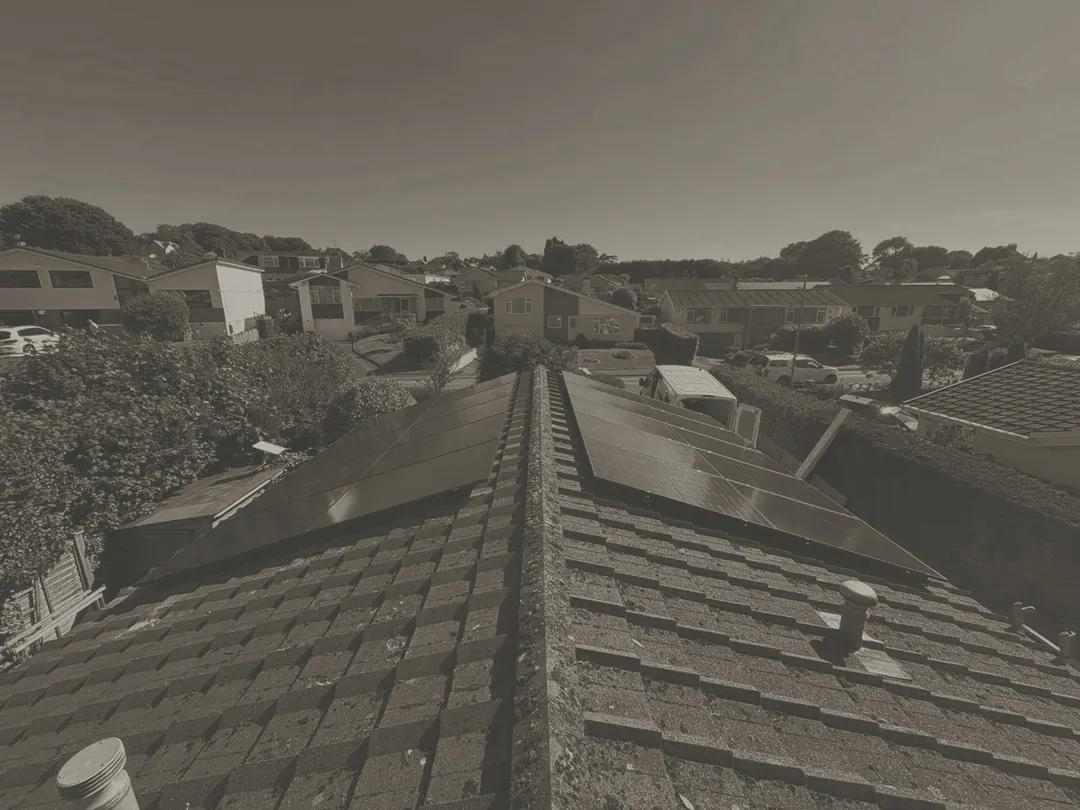
Solar PV is the technology inside the solar panels you see on roofs, barns and fields across Devon and Cornwall. PV is short for photovoltaic, and the idea behind it is simple: certain materials turn daylight directly into electricity. A solar PV system puts that to work, generating electricity on your property for your home, farm or business to use.
This guide explains what solar PV is, what each part of a system does, the units you’ll see on a quote, and what happens to the electricity you don’t use. We design and install solar PV and battery storage for homes and farms across Devon and Cornwall, and for businesses across most of England, from our base near Okehampton.
What does solar PV mean?
“Photovoltaic” joins two ideas: photo, meaning light, and voltaic, meaning electricity. A photovoltaic cell, also called a solar cell, is made from a semiconductor, most commonly silicon. When light falls on the cell, the silicon absorbs the light’s energy and passes it to electrons in the material. That extra energy lets the electrons flow as an electric current, which is collected by the thin metal lines you can see across the face of a cell.
Cells are wired together into a panel, sometimes called a module, and panels are wired together into an array. The electricity they produce is direct current (DC), the same kind a battery produces. Homes, farms and the grid run on alternating current (AC), so a solar PV system for a property includes an inverter to convert one into the other.
One point that often causes confusion: solar PV makes electricity. Solar thermal panels, also called solar water heating, do a different job. They use the sun’s energy to heat water in a hot water cylinder. Both sit on a roof, but they are different technologies, and this guide is about PV.
The parts of a solar PV system
A grid-connected system is made up of these parts:
- Solar panels. The part you see. They turn daylight into DC electricity.
- Mounting system. The frame that holds the panels on a pitched roof, a flat roof, a barn roof or a ground-mounted frame. On a pitched roof, panels can sit above the tiles or be set into the roof itself.
- Inverter. Converts DC into AC. Some systems use one inverter for the whole array; others use a small microinverter on each panel, which helps where part of the roof is shaded.
- Consumer unit. Your fuse box. The system connects here, so the electricity reaches the circuits in your home or building.
- Meter. Records the electricity you buy from the grid and, where it can take half-hourly readings, the electricity you export to it.
- Battery (optional). Stores electricity your panels make during the day so you can use it later, for example in the evening. If that matters to you, our page on home battery storage explains the options.
Panels are the part people notice, but the inverter does much of the work, and the design of the whole system decides how well it performs. That’s why we choose the equipment around the property rather than starting from a box.
kW, kWh and kWp: the units on your quote
Three units come up again and again. They measure different things, and they’re easy to mix up.
| Unit | What it measures | Where you’ll see it |
|---|---|---|
| kW (kilowatt) | Power: the rate at which electricity is made or used | Inverter and battery power ratings, and how much power an appliance draws |
| kWh (kilowatt hour) | Energy: power over time, so one kW for one hour is one kWh | Your electricity bill, which charges per kWh, and battery capacity |
| kWp (kilowatt peak) | The rated size of a solar array: its maximum output in ideal conditions | The size of the system on your quote |
A simple way to keep the first two apart: kW is the speed, kWh is the distance. A 2 kW heater left on for half an hour uses one kWh; so does a 1 kW heater left on for an hour.
kWp is worth a closer look. Because it’s measured in ideal conditions, it tells you how big a system is, not what it will produce on a particular day. What a system actually generates depends on the direction and pitch of your roof, any shading and the weather. That’s why we design each system around the property instead of selling it from a price list.
The types of solar PV system
There are three ways to set solar PV up:
- Grid-connected. The system is connected to the electricity network. Your property uses solar electricity when it’s available and draws from the grid when it isn’t, and electricity you don’t use can be exported.
- Grid-connected with a battery. Often called a hybrid system. It works the same way, with a battery to store surplus electricity for later. The grid is still there when the battery runs low.
- Off-grid. No connection to the network at all. Batteries store energy for when the sun isn’t shining, and the system has to cover every need on its own.
Most of this guide is about the first two. One thing worth knowing about both: a grid-connected system is designed to switch itself off if the grid goes down, so panels on their own won’t keep your lights on in a power cut. Backup power is possible where it’s included and suitable, and we’ll tell you plainly whether yours can.
What happens to the electricity you don’t use?
Your property uses solar electricity first, as it’s generated. When the panels make more than you need, the surplus goes to the battery if you have one, then out to the grid through your meter.
You can be paid for the electricity you export. These export payments come through the Smart Export Guarantee (SEG), a government-backed scheme overseen by Ofgem, the energy regulator, which started on 1 January 2020. Under the SEG:
- electricity suppliers with at least 150,000 domestic customers must offer at least one export tariff, and smaller suppliers can choose to;
- each supplier sets its own rate and contract terms, but the rate must always be above zero;
- you can choose any supplier offering a SEG tariff, and it doesn’t have to be the one you buy electricity from;
- your installation needs an MCS certificate, or an equivalent certification, and a meter that can take half-hourly readings of what you export.
MCS stands for the Microgeneration Certification Scheme. We’re MCS certified for solar PV and battery storage (certificate NIC-601527), so the systems we install can be registered for export payments.
Exporting isn’t the only option, and it often isn’t the most valuable one. Buying a unit of electricity usually costs more than you’re paid for exporting one, so it often makes sense to use as much of your own solar electricity as you can, whether by running appliances in the day or by storing it in a battery for the evening.
Is solar PV right for your property?
Solar PV works best on an unshaded roof facing south. East- and west-facing roofs still work, but north-facing roofs aren’t recommended. Beyond the roof, a few things decide whether it’s a good fit:
- Your roof or land. Orientation, pitch, shading and space all matter. Flat roofs and ground-mounted systems are options too, ideal for farms, commercial premises and properties without suitable roof space.
- When you use electricity. Solar generates in daylight, so the more of your electricity you use during the day, the more of the solar output you use directly. On a farm, that means looking at when electricity is needed for milking, refrigeration and ventilation, which is where our work on solar panels for farms starts. Businesses with daytime demand are in a similar position, and our page on commercial solar panels covers them.
- Your evenings. If most of your use comes after dark, a battery lets you store daytime electricity for later.
- Planning permission. In most cases it isn’t required. Exceptions apply in conservation areas, on listed buildings and in national parks, and we’ll advise you during your survey if permissions are needed.
On a site survey we look at your roof’s orientation, shading and space, and you can send us a copy of a recent electricity bill so we can see how you use energy. We then design the system with Easy PV Pro, which sets out the number of panels and your battery options. Our page on solar panel installation explains how we work. If you’re still deciding, our answers to 10 common doubts about solar panels may help.
Solar PV in short
Solar PV turns daylight into electricity. The cells make DC, the inverter turns it into AC, your property uses it first, and anything left over is stored in a battery or exported to the grid for an export payment. To see what each part does in more detail, read how solar panels work, step by step. If you’d like to know what solar PV could do on your roof, book a free site survey or ask our team for a design through our Solar PV Designer page.