Guide
Fox ESS inverters explained: H1-G2, KH, H3 and the AC-coupled models
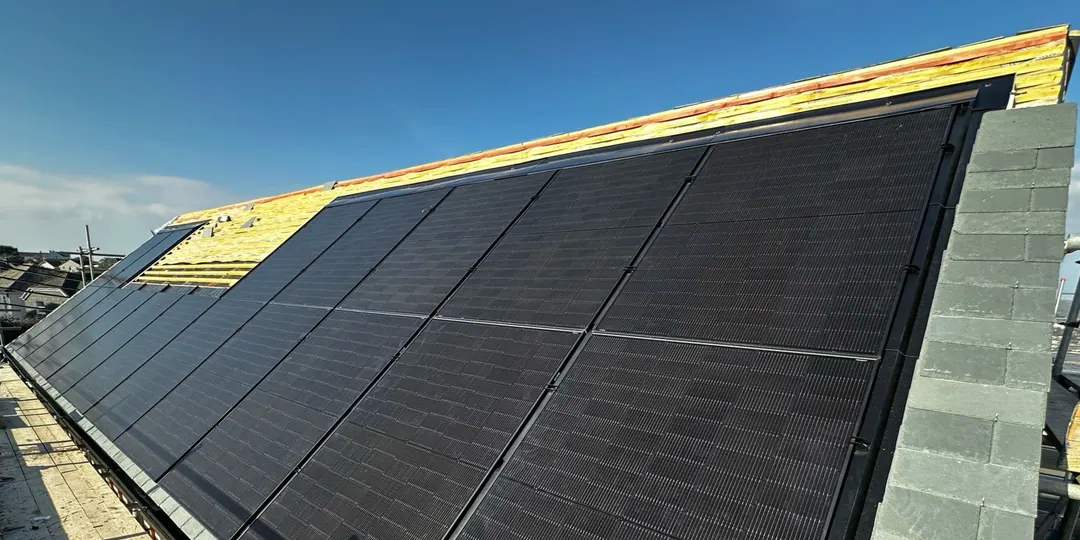
A Fox ESS inverter is the box that turns the direct current (DC) from your solar panels into the alternating current (AC) your home and the grid use. Fox’s hybrid models run a battery as well, so one inverter looks after the panels and the storage together.
This guide takes each Fox range in turn, from Fox ESS’s own UK product pages and its datasheets dated April to December 2025, all checked on 2 November 2026: the supply each model is built for, the batteries it takes and when it suits. Our page on Fox ESS systems we install covers how our own team designs and fits them. If DC and AC are new terms, our guide to what solar PV is covers the basics first.
Hybrid or AC-coupled: how a Fox ESS inverter connects
Fox describes two ways to bring a battery into a solar system, plus a third option for later:
-
DC-coupled. The panels and the battery share one hybrid inverter. Fox calls this “Ideal for new installations”.
-
AC-coupled. The battery runs through its own inverter, connected alongside the solar inverter you already have. Fox calls this “Perfect for retrofits”.
-
Battery ready. A hybrid fitted without a battery, so storage can follow “with no system redesign”, in Fox’s words.
The H1-G2 covers the most ground: Fox calls it “a true hybrid inverter, capable of operating in both DC-coupled and AC-coupled configurations”. The AC1-G2 and KA are the dedicated AC-coupled models. Their datasheets mark the solar input rows “only for hybrid” and “for KH only”, so they have no connection for panels of their own.
The Fox ESS range at a glance
| Range | Supply | Sizes Fox lists | Panels connect directly | Fox’s positioning |
|---|---|---|---|---|
| H1-G2 | Single phase | 3, 3.7, 5 and 6 kW | Yes, 2 MPPTs | “Modern homes” |
| AC1-G2 | Single phase | The H1-G2’s sizes | No | Existing solar |
| KH | Single phase | 7, 8, 9 and 10 kW | Yes, 3 or 4 MPPTs | “Larger arrays” |
| KA | Single phase | The KH’s sizes | No | Existing solar |
| H3 Smart | Three phase | 5 to 15 kW | Yes, 3 MPPTs | Large homes, smaller businesses |
| H3 Pro | Three phase | 15 to 30 kW | Yes, 3 MPPTs | “High-demand sites” |
An MPPT (maximum power point tracker) is a separate solar input. Each one on the H1-G2 and KH takes one string of panels.
H1-G2: single-phase hybrid, 3 to 6 kW
Fox’s UK page lists the H1-G2 “in 3, 3.7, 5 and 6kW models”, and the datasheet adds a 4.6 kW model. Each takes a solar array of up to twice its rating, from 6,000 Wp on the 3 kW model to 12,000 Wp on the 6 kW, which Fox calls a “200% PV oversize ratio”. The datasheet also gives:
-
Maximum efficiency of 97.01% to 97.08%, depending on the model.
-
A backup output with a battery of 3,000 to 6,000 VA, matching the inverter’s size, with a switch time under 10 milliseconds.
-
Wall mounting, a weight of 22 kg and an IP65 rating, “Suitable for outdoor installation”.
The 3.7 kW model is sized to a single-phase limit explained below: its datasheet gives a maximum output of 3,680 VA “for G98”.
AC1-G2: a battery for the panels you already have
Fox says “the AC1-G2 provides a dedicated AC-coupled solution, ideal for adding storage to existing PV systems.” It shares the H1-G2’s datasheet and sizes without the solar inputs, so your existing inverter carries on running the panels and the AC1-G2 connects alongside it to run the battery.
It isn’t the only route. Some systems are better suited to replacing the existing inverter with a hybrid one, and our page on adding a battery to your existing solar explains how we decide, including for panels another company fitted.
KH and KA: single-phase for larger arrays
Fox’s UK page describes the KH/KA Series as “Designed for larger single-phase arrays”, “in 7, 8, 9 and 10kW options, with 3 or 4 MPPTs”, and the datasheet adds a 10.5 kW model. The KA, without solar inputs, is the AC-coupled member, and Fox says the series can be “installed with or without panels (AC-coupled)”. From the datasheet:
- Solar array: up to 15,000 Wp on the KH7, rising to 21,000 Wp on the KH10.5.
- Maximum efficiency: 97.80%.
- Backup output with a battery: 7,000 to 10,500 VA, switching in under 6 milliseconds.
- Weight: 29 kg for the KH and 27.5 kg for the KA, rated IP65.
- Grid standards: the certification row lists G99, with no G98.
That last line follows from the size: the KH7’s nominal AC current is 30.4 A, far over the 16 A single-phase line explained below.
H3 Smart and H3 Pro: the three-phase hybrids
Fox calls the H3 Smart “a compact three-phase hybrid inverter and AC charger” for “smaller commercial and large residential projects”, in “5, 6, 8, 10, 12 and 15kW model options”. The H3 Pro, “available in 15, 20, 25, and 30kW model options”, is “designed for high-demand sites”.
| H3 Smart | H3 Pro | |
|---|---|---|
| Battery inputs | 1 | 2 |
| Largest battery per inverter, with CQ7 | 84.24 kWh | 168.48 kWh |
| Backup switch time | Under 10 ms | Under 10 ms |
| Maximum efficiency | 97.30% to 97.90% | 97.10% to 97.20% |
| Net weight | 34 kg | 52.5 kg |
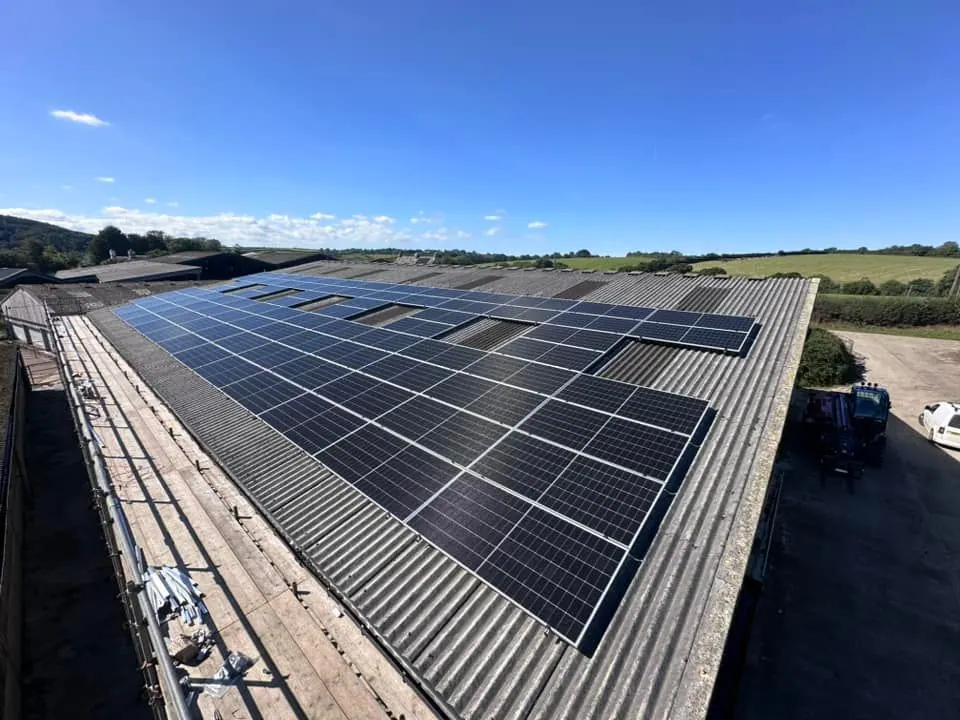
Both can run up to 10 units in parallel, which Fox says “Requires AI Link”, and both can go in without a battery “as a grid-tied, battery-ready inverter”. If you run a farm or business on a three-phase supply, our pages on solar for farms and commercial solar for businesses explain how we plan around daytime loads.
Which batteries each Fox ESS inverter takes
Every inverter here pairs with Fox’s own high-voltage batteries: the EP range, which connects in parallel, and EQ and CQ modules, which stack in series. These are the capacity ranges Fox’s UK pages give for four of them:
| Battery | H1-G2, AC1-G2, KH, KA | H3 Smart | H3 Pro |
|---|---|---|---|
| EP6, 5.76 kWh each | 5.76 to 23.04 kWh | 5.76 to 23.04 kWh | 5.76 to 46.08 kWh |
| EP12, 11.52 kWh each | 11.52 to 46.08 kWh | 11.52 to 46.08 kWh | 11.52 to 92.16 kWh |
| EQ4800, 4.66 kWh each | 9.32 to 41.94 kWh | 9.32 to 41.94 kWh | 13.98 to 83.88 kWh |
| CQ7, 7.02 kWh each | 14.04 to 49.14 kWh | 21.06 to 84.24 kWh | 28.08 to 168.48 kWh |
Fox’s single-phase pages note that two to four EP batteries need a junction box, and the H3 Smart page says “Battery models should not be mixed”. Capacity on paper is only half the question: our page on battery storage sized to your evenings explains how we match it to your use.
Backup in a power cut: EPS output and the EPS-BOX-SP
Each datasheet lists anti-islanding protection, and National Grid Electricity Distribution (NGED), the network operator for Devon and Cornwall, says that without a standby or island mode, “your generation system will be designed to shut down during a power outage.” With a battery, Fox’s inverters can do more: each lists a backup output, which Fox labels EPS.
For whole-home cover on a single-phase supply, Fox makes the EPS-BOX-SP, “a single-phase whole-home backup gateway” that works with the H1-G2, AC1-G2, KH and KA. Fox says it “restores power using battery and solar” after “A short interruption (typically 2–3 seconds)”, and “Supports full-home backup (subject to system sizing.)”
Backup is only possible where it is included and suitable, and which circuits stay on depends on the design. Our guide to power cuts in Devon and Cornwall covers who to call when the grid goes down.
Single-phase or three-phase: what your supply decides
NGED says “The majority of NGED’s customers are single phase (1ph) connected”, so for most of its customers the choice is among the H1-G2, AC1-G2, KH and KA. Your supply also decides the paperwork. NGED’s G98 process covers generation “with an aggregate registered capacity of 16A (3.68kW) per phase or less”, counting the inverter’s rating rather than the panels’ and adding up every unit at the property. Its G99 process covers “generation and energy storage installations” rated above that. In practice:
-
A 3.7 kW H1-G2 on its own stays within G98’s limit, with its datasheet giving 3,680 VA for G98. NGED lets a G98 system be fitted first, with the installation document sent within 28 days.
-
An AC1-G2 beside an existing solar inverter adds its rating to the existing one, as NGED’s G98 forms cover generation and storage alike.
-
Any KH is over that limit on a single phase, hence G99 on its datasheet.
-
On three phases, NGED divides the rating across the phases: its example puts a 9 kW three-phase generator at 13.04 A per phase.
Where a system needs approval from National Grid before we connect it, called a G99 application, we handle it for you.
Fox Cloud monitoring and Fox’s UK support
The H1-G2 and KH datasheets both list WiFi, with LAN as an option on the H1-G2, and Fox calls both “Smart tariff compatible”. Fox Cloud, its monitoring platform, lets you “monitor real-time performance, review historical data, and adjust settings to suit your lifestyle or energy tariff”, in a web browser or the Fox ESS app. At handover, we show you how the system works and how to follow it in the app.
Fox ESS describes itself as “a Sino-British partnership”, and calls its Coventry Service Centre “the hub of FoxESS UK operations”. If an inverter you already have shows a fault, our repairs and fault-finding service works on systems we didn’t fit as well as our own.
Choosing a Fox ESS inverter with us
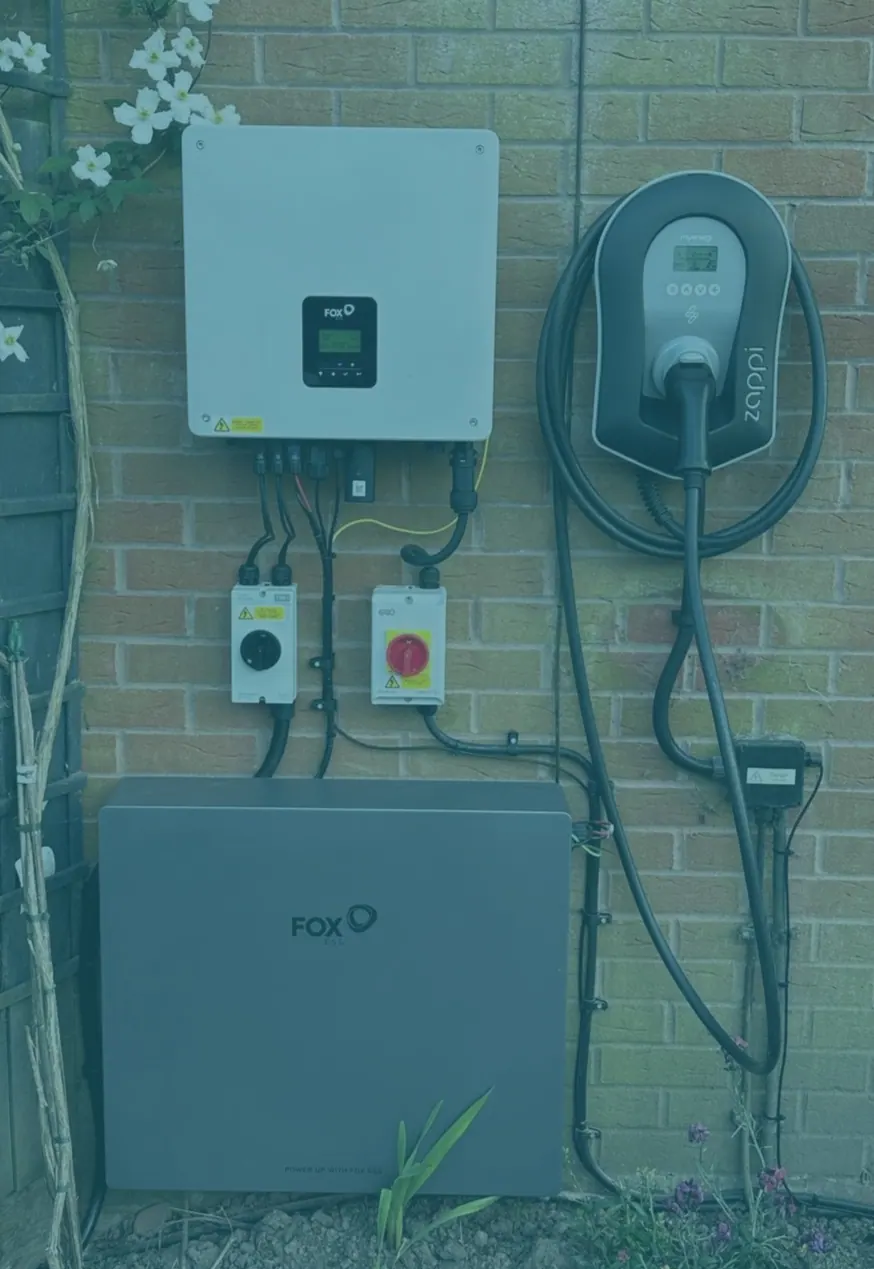
We fit inverters and batteries from three makers, Sigenergy, EcoFlow and Fox ESS, so we’re not tied to one, and if Fox ESS isn’t the right fit for your property, we’ll say so. Every system starts with a free site survey and a no-obligation quote. We look at your property, your roof and how you use electricity, then design the system in Easy PV Pro, and our own installation team fits it.
We work for homes around Plymouth and across Devon and Cornwall from our base near Okehampton, and every installation includes a year of The Solar Owners Club. Whether you’re adding a battery to panels you already have or starting from scratch, we’ll explain which Fox ESS inverter suits your home, and why.