Guide
Is a 10kW Solar System Enough to Run a House? What It Makes in Devon and Cornwall
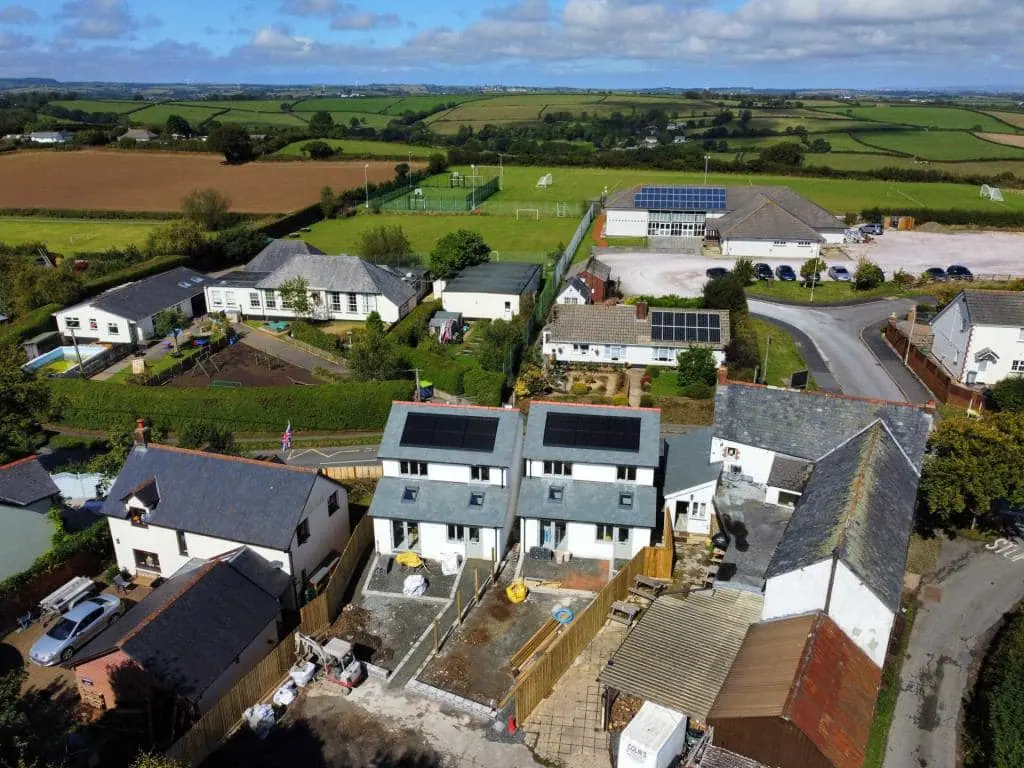
A 10kW solar system is a large array for a home, and the first questions are how much it will make here, whether it will run the house and how many panels it takes. This guide answers all three for Devon and Cornwall with figures we modelled ourselves, then covers the network operator’s approval, export limits and batteries.
What a 10kW solar system makes in Devon and Cornwall
We ran PVGIS, the EU Joint Research Centre’s solar modelling tool, for a south-facing 10kW array near Okehampton, which like our base is in West Devon, and near Truro in Cornwall.
| Month | Okehampton, kWh in the month | Okehampton, kWh a day | Truro, kWh in the month | Truro, kWh a day |
|---|---|---|---|---|
| January | 352 | 11.4 | 388 | 12.5 |
| February | 502 | 17.9 | 580 | 20.7 |
| March | 881 | 28.4 | 912 | 29.4 |
| April | 1,159 | 38.6 | 1,220 | 40.7 |
| May | 1,221 | 39.4 | 1,285 | 41.5 |
| June | 1,178 | 39.3 | 1,271 | 42.4 |
| July | 1,172 | 37.8 | 1,254 | 40.4 |
| August | 1,067 | 34.4 | 1,163 | 37.5 |
| September | 909 | 30.3 | 980 | 32.7 |
| October | 601 | 19.4 | 678 | 21.9 |
| November | 426 | 14.2 | 458 | 15.3 |
| December | 312 | 10.1 | 343 | 11.1 |
| Year | 9,782 | 26.8 | 10,531 | 28.9 |
May is the best month on both roofs, December makes about a quarter of May’s output, and Truro, further south and west, comes out about 8% ahead over the year. A 12kW array scales in step: the same Okehampton roof gives 11,738 kWh a year, 1.2 times the 10kW figure.
How we ran the numbers
- Data: PVGIS 5.2, run through its API on 2 November 2026, with PVGIS-SARAH2 satellite data averaged over 2005 to 2020.
- Places: 50.74° N, 4.00° W near Okehampton, and 50.26° N, 5.05° W near Truro.
- Array: 10kWp of crystalline silicon panels, facing due south, tilted at 35°.
- Losses: 14%, PVGIS’s default for losses in cables, the inverter, dirt on the panels and so on.
- Mounting: PVGIS’s “free-standing” setting, with air flowing behind the panels. PVGIS says some roof mountings, such as panels over curved roof tiles, fall between that and its hotter-running “building-integrated” setting.
- Shade: PVGIS allows for shadows from nearby hills. Trees, chimneys and the house next door are for the survey to find.
kWp means kilowatts peak, the array’s rated size in ideal conditions. Our guide to what solar PV is, with kW, kWh and kWp explained covers the units.
Good years, grey years and your own roof
PVGIS puts the year-to-year swing, as one standard deviation, at about 370 kWh for the Okehampton roof and 420 kWh for Truro. December alone has a standard deviation of about 55 kWh around its 312 kWh average. For how far one year can stand out, see our look back at 2025, a record year for UK solar.
Your own roof matters more. Energy Saving Trust notes that nearby buildings, trees or chimneys can shade a roof and hurt a system’s performance, and pitch and direction change the result too. That’s why we design from a survey of the actual roof.
Can 10kW really power a home on its own?
Over a year, comfortably. Ofgem now uses 2,500 kWh a year as its medium household electricity figure, and the Okehampton roof makes nearly four times that. Day by day:
- A medium home, with Ofgem’s figure spread evenly: just under 7 kWh a day.
- The 10kW Okehampton roof in June: about 39 kWh a day.
- The same roof in December: about 10 kWh a day.
The catch is timing. The panels make nothing after dark, and winter evenings start early. A heat pump or an electric car adds to your use as well. Without a battery, evenings and nights still run on the grid, however big the array.
In June it flips: most of the day’s output is more than a medium home can use as it’s made, so it charges a battery or is exported. A 10kW array makes enough over a year, but it can’t run your evenings alone.
How many panels make 10kW, and how much roof
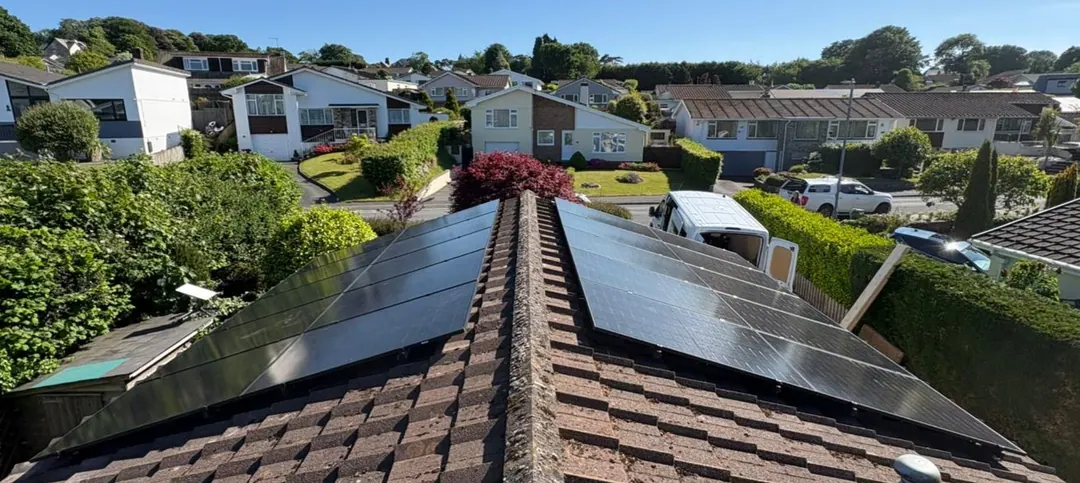
Divide 10,000 watts by the panel’s own rating, printed on its datasheet. Energy Saving Trust puts the average home system at around 4.5kWp, covering 20 to 30 square metres of roof with around 12 panels. Scaled to 10kWp, the same panels come to about 27, on roughly 44 to 67 square metres, and higher-rated panels bring the count down.
That can be more than one face of a house roof holds, so a 10kW array may spread over two faces, or onto a garage or outbuilding. We also design ground-mounted systems for homes without suitable roof space.
When the roof faces east and west
Energy Saving Trust says a system facing east or west tends to get around 15 to 20% less energy than one facing directly south. Our PVGIS run for 5kW facing east plus 5kW facing west near Okehampton, with the same tilt and losses, gave 7,943 kWh a year, about 19% below the south-facing 10kW. The gap isn’t even through the year:
- June: 1,131 kWh against 1,178 kWh, about 4% less.
- March: 645 kWh against 881 kWh, about 27% less.
- December: 147 kWh against 312 kWh, more than half gone.
If winter output matters to you, we’ll weigh that in the layout.
Single-phase, three-phase and the network operator
Every grid-connected system must be notified to, or approved by, the network operator, which across Devon and Cornwall is National Grid Electricity Distribution (NGED). NGED says the majority of its customers are single-phase. What decides your route is the inverter’s rating in amps per phase, not the panels’ kWp.
| NGED route | Limit per phase | What happens |
|---|---|---|
| G98 | Everything at the property rated 16A (3.68kW) or less in total | Fit first, then send NGED the installation document within 28 days of commissioning |
| G99 fast track, SGI-2 | Each device no more than 16A, total no more than 32A, with a G100 export limitation scheme holding export to 16A | Apply before fitting: acceptance within 10 working days, then up to 3 months to fit and commission |
| G99 fast track, SGI-3 | Each device no more than 32A, total no more than 60A, export held to 32A | Apply before fitting: NGED’s network study result within 10 working days, and a G99 enquiry if it fails |
| G99 standard | Anything else | A full application, with a simplified process for 17kW or less on a single phase |
On a single phase, NGED’s sum gives a 10kW inverter about 43A (10,000 ÷ 230), over G98’s limit and over the fast tracks’ 32A per device. So it takes the standard G99 route and needs NGED’s approval before we can connect it. On three phases, NGED’s own worked example puts a 9kW generator at 13.04A per phase, and the same sum gives 10kW about 14.5A, under the 16A line. The equipment’s rating on each phase settles it, and where an application is needed, we handle it for you.
Export limits and the inverter
Because NGED counts the inverter, two design choices help a larger array fit the network:
- An inverter smaller than the array. Sigenergy’s single-phase Energy Controllers, rated from 3kW to 12kW, take a DC/AC ratio as high as 2.0, so panel capacity of twice the inverter’s output. In the brightest hours such an array can make more than the inverter passes on, but in the dull months the extra panels keep it busier.
- Export limitation. A G100 scheme caps what the system sends to the grid, which is how NGED’s SGI-2 and SGI-3 fast tracks allow more generation behind the meter than goes out through it.
Whatever is exported can earn payments under the Smart Export Guarantee (SEG), and suppliers paying them ask for proof of certification. Ours is MCS certificate NIC-601527.
Pairing a 10kW array with a battery
A battery doesn’t change how much the panels make, only when you can use it. An average June day near Okehampton makes about 39 kWh, far more than a battery sized to a medium home’s evenings can hold, so the battery fills and the surplus exports. In December, at about 10 kWh a day, much more of the output goes straight into the house.
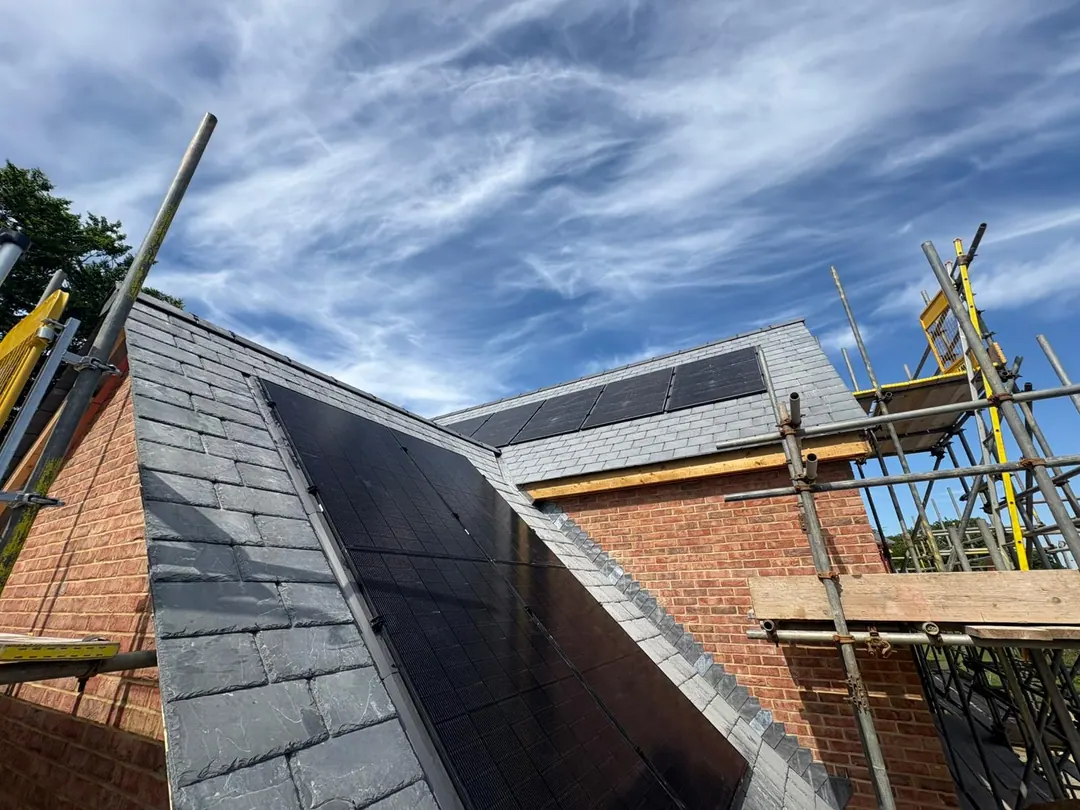
So the battery should match your evening and overnight use, not the array. We size it from your bills and your daily routine, and if a smaller battery is the right answer, that is what we recommend. For scale, Sigenergy’s SigenStor modules hold 5.84 kWh or 8.76 kWh of usable energy each, with one to six per Energy Controller. See the Sigenergy SigenStor systems we install, or how we choose solar battery storage sized to your evenings.
A battery also counts towards NGED’s limits, because its fast-track rules add up all the generation and storage at the property. A hybrid inverter runs the panels and the battery together, while a battery with its own inverter brings a second rating into the sum. Already have panels? Our page on adding a battery to existing solar covers both routes.
What to check before you ask for a quote
None of this is needed to book a survey, but it helps us size the system:
-
Your electricity use in kWh, from a recent bill.
-
Which way your roof faces, and what shades it during the day.
-
Any plans for a heat pump or an electric car charger.
-
Where a battery could go, such as a garage or utility room.
-
Whether backup power in a power cut matters, as not every system provides it.
-
Whether your supply is single-phase or three-phase, if you know. If you don’t, that’s fine, and there’s no need to open anything to find out.
How we design a larger system
Every system starts with a free site survey: about an hour checking the roof’s orientation, shading and space, and talking through how you use electricity. We design it in Easy PV Pro, and your no-obligation quote sets out the design and its estimated savings, based on your use. Our own DBS-checked team fits it, and homes usually take one to three days. The work carries our 10-year workmanship warranty, and a year of The Solar Owners Club, with its annual system health check, is included.
Our page on solar panel installation for your home sets out each step, and we work with homes right across Devon from our base near Okehampton. If a 10kW solar system suits your roof and your use, we’ll design it properly. If a smaller system would serve you better, we’ll tell you.