Guide
How Do Solar Panels Work? A Simple Breakdown
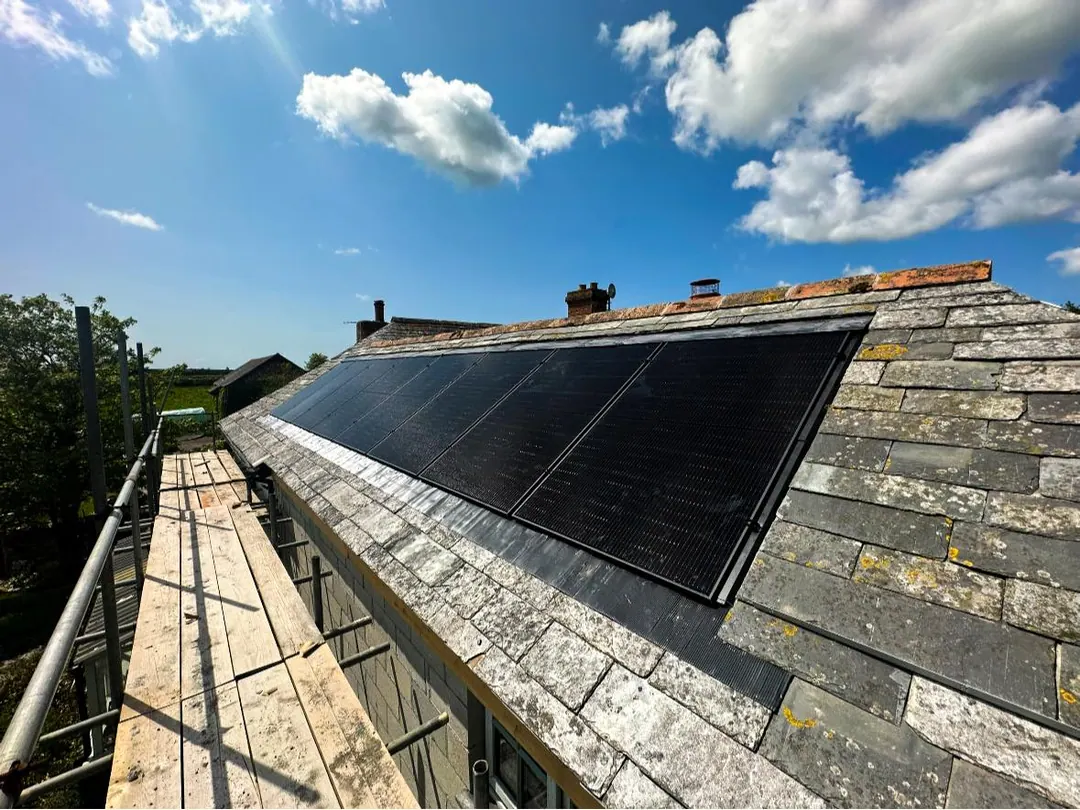
Nothing burns and nothing needs refuelling: the panels generate whenever there’s daylight, and the rest of the system decides where the electricity goes.
This guide follows that electricity from your roof to your sockets, then explains what happens in the evening, at night and in a power cut. We design and install solar panels and battery storage for homes and farms across Devon and Cornwall from our base near Okehampton.
How do solar panels work? The short version
- Daylight reaches the cells. Each panel is made of photovoltaic cells. They don’t need direct sunshine to work, although stronger sunshine means more electricity.
- The cells make direct current (DC). Light energy frees electrons in the silicon, and they flow as an electric current.
- The inverter converts it. DC becomes alternating current (AC), the kind your appliances and the grid use.
- Your home uses it first. The electricity passes through your consumer unit, your fuse box, to whatever is switched on.
- The surplus is stored or exported. Anything you don’t use charges a battery if you have one, or flows out to the grid through your meter.
Inside a solar cell
A solar cell is a thin slice of semiconductor, most commonly silicon. “Semi” because it conducts electricity better than an insulator but not as well as a metal. When daylight falls on the cell, the silicon absorbs the light’s energy and passes it to electrons in the material. An electrical field built into the cell moves those charges in one direction, and that movement is an electric current. Thin metal contacts, the grid-like lines on the face of the cell, collect it.
Cells are wired together into a panel, and panels into an array. The cells in modern panels look dark blue or black because they’re made to reflect as little light as possible: the less light a cell reflects, the more it can turn into electricity.
Not all the light that reaches a cell becomes electricity. Some is reflected, some passes straight through and some turns into heat. That heat matters, because solar cells generally work best when they’re cool. Higher temperatures reduce the voltage a cell produces, so a bright, cold spring day can be a very good day for solar.
The parts that make it work
| Part | What it does |
|---|---|
| Solar panels | Turn daylight into DC electricity |
| Mounting system | Holds the panels at a fixed angle on a roof or ground frame, built to cope with wind and rain for decades |
| Inverter | Converts DC into AC for your home and the grid |
| Consumer unit | Your fuse box: sends electricity to the circuits in your home |
| Battery (optional) | Stores surplus electricity to use later |
| Meter | Records what you import from the grid and what you export to it |
| Monitoring app | Lets you follow what your system is generating, using and storing |
The inverter does more than people expect, and there are different kinds:
- A string inverter handles the whole array from one box.
- Microinverters sit behind each panel, so one shaded panel doesn’t hold back the rest.
- Optimisers fit to individual panels and work alongside a central inverter, so shading on one panel doesn’t affect what the others generate.
- A hybrid inverter manages the panels and a battery together. Other systems keep the panels’ inverter and add a separate battery inverter, which converts AC back into DC to charge the battery.
Panels and inverters age differently. Solar panels should last 25 years or more, while the inverter is likely to need replacing at least once in that time, so it’s worth knowing which one you have and what its warranty covers.
We fit Sigenergy systems, EcoFlow PowerOcean and Fox ESS inverters and batteries, and we choose them around the job. We’re not loyal to a box. We’re loyal to the right system.
Where the electricity goes: your home, a battery, then the grid
During the day, your home uses solar electricity as it’s generated. The kettle, the washing machine, the fridge: whatever is switched on takes solar power first, and you only draw from the grid for anything the panels can’t cover at that moment.
When the panels make more than you’re using, the surplus has two places to go. If you have a home battery, it charges first. Once the battery is full, or if you don’t have one, the surplus flows out to the grid through your meter.
Electricity you export can earn export payments through the Smart Export Guarantee (SEG). To qualify, your system needs an MCS certificate (MCS is the Microgeneration Certification Scheme) or an equivalent, and a meter that can take half-hourly readings. We’re MCS certified for solar PV and battery storage, and our guide to what solar PV is covers how the SEG works.
Buying a unit of electricity usually costs more than you’re paid for exporting one, so timing matters. The more of your electricity you use while the panels are generating, the more of their output you use directly. On a farm we look at when electricity is needed for milking, refrigeration and ventilation, which is where solar for farms starts; for solar for businesses, it’s about operating hours and daytime demand. If you already have panels and export much of what they make, you can add a battery to an existing system to keep more of it for the evening.
What happens in the evening, at night and in a power cut
As the light fades, the panels produce less, and at night they produce nothing. From then on:
- A battery takes over, if you have one. It releases the electricity it stored during the day.
- The inverter converts it back. Batteries store DC, so the inverter turns it into AC for your home.
- Your consumer unit sends it where it’s needed. Lights, cooking, the evening’s washing.
- The grid fills any gap. When the battery runs low, or if you don’t have one, your home draws from the grid automatically.
A power cut is different. Grid-connected systems are built to switch off if the grid goes down. This loss-of-mains protection is part of the rules for connecting generation to the electricity network, known as G98 and G99, and it stops your system feeding electricity into cables that engineers may be working on. It’s tested when the system is commissioned. So panels on their own won’t keep the lights on in a power cut. Some battery systems can supply backup power to the home; backup power is possible where it’s included and suitable, and we’ll tell you plainly whether yours can.
What affects how well solar panels work
- Direction and tilt. An unshaded, south-facing roof is ideal. East- and west-facing roofs still work; north-facing roofs aren’t recommended.
- Shade. Trees, chimneys and nearby buildings can reduce performance. Microinverters or optimisers can limit the effect where shade can’t be avoided.
- Weather. Panels still generate on cloudy days, at reduced output, and they generate more in bright sunshine.
- Temperature. Cells work best when they’re cool, so the hottest days aren’t automatically the most productive.
- Dirt and debris. In the UK, rain cleans panels tilted at 15 degrees or more. Ground-mounted panels, or panels in dusty areas, may need cleaning now and then.
- Condition. Occasional cleaning and a professional inspection once a year help spot problems early. Our page on regular solar panel maintenance explains what an inspection covers, and our guide to the signs your solar panels aren’t working as they should tells you what to look out for in between.
From survey to switch-on
How solar panels work on paper is one thing; how they work on your roof depends on the design. This is how we approach it:
- Site survey. We look at your roof’s orientation, shading and space, and you can send us a copy of a recent electricity bill so the design reflects how you use energy.
- Design. We design the system with Easy PV Pro, which sets out the number of panels and your battery options. The right system, not the biggest one.
- Approval. Your system may need approval from National Grid before we can connect it. This is called a G99 application. We handle the application for you and keep you updated while we wait for their response.
- Installation. Our own installation team fits the system. Homes usually take one to three days; larger projects take a little longer.
- Handover. We show you how it works and how to follow it in the app. Your installation comes with a 10-year workmanship warranty, separate from the manufacturers’ own product warranties, and one year of The Solar Owners Club included.
Our page on solar panels designed around your home explains more about how we work, and you can arrange a site survey when you’re ready.
Understanding how the parts work together makes it easier to judge any quote, including ours.